Wednesday, April 29, 2009

Feature Interview with Neal Shusterman!


This is an awesome story with a satisfying, tight plot, developed and complex characters, and a gripping premise. Marked for Unwinding, a medical process which donates all of a person’s organs while they remain “technically” alive, Connor, Risa and Lev are on the run to evade the government who would round them up and put them in harvesting camps. But Unwind pushes far beyond a simple dystopian action tale. All through Unwind characters deal with questions of morality, the nature of consciousness and the existence of the soul. A remarkable book, one of that best that I’ve read in a while. Recommended for those 13 and up, or for anyone looking for great Science Fiction!
Recently, I had the extreme good fortune to interview Neal Shusterman and ask him some questions about Unwind.


(Mandy) In a big way Unwind explores the, for many, troubled time between the age of 13 and 18. A period when the struggle to grow up and know yourself is expressed with defiance or laziness or even violence. It’s a tough time for parents as their kids pull away emotionally and are unreachable and therefore their actions are judged more harshly. You explore the darkness of this time with the state sanctioned law of unwinding, a procedure that disassembles a person completely for organ donation. Parents are allowed to choose if and when they unwind their child, and you explore the various reasons that parents might choose this. How did the idea of unwinding come to you?


(Neal) It was a combination of two things that got me motivated to write unwind. First was the way issues like abortion, stem cell research, etc. have become so polarized, that people are actually using these issues as the main criteria for which candidate they vote for. As a society we’ve lost sight of these issues, and it has become an “us vs. them” mentality, that hurts the situation rather than helps it. I wanted to tell a story of what could happen if we continue on our current path. The idea was to not to take a side — to be as neutral as possible, and attack both sides equally. I wanted to point out that the fact there are two sides at all, is a big part of the problem. These issues are not black-and-white — they all fall into areas of gray, and as soon as we accept that as a society, we’ll be able to deal with them a whole lot better. I had roughly conceived of the idea, but it really gelled when I read an article about transplant technology. One scientist said that he predicted that within our lifetimes, they will be able to use 100% of an organ donor’s body. That got me thinking — if 100% of you is alive, are you alive or not? I thought this book was a great way to ask that question, and through that question, address all these issues of medical and social ethics.


Why did you choose the ages between 13 and 18?


Quite often the same people who see children as sweet and innocent, will see teenagers as scary and threatening. I wanted to point out that particular hypocrisy of society. Plus, kids tend to feel alienated from their families as teenagers. They feel like the natural targets of a society-gone-wrong.


I loved the big questions asked in Unwind. Characters run up against questions of morality, the nature of consciousness and the existence of the soul. I’m not sure if there is a question in this, but how important are these concerns for teens to grapple with, and generally for humans to answer for themselves?


I think asking these types of questions are at the core of being human — not just for teens, but adults as well. I like to ask the “big questions” in my books, in different and unique ways that will provoke thought, and help readers look at things from fresh perspectives. I don’t give answers though. There are no simple answers to life’s tough questions — that’s one of the points I’m always trying to make. It’s my job to pose the questions. I don’t want to tell you what to think, but rather I want to suggest what you might be thinking about. With Lev’s character you traverse the shadowy moral issue of political violence, when and if it is ever justified. Without giving too much away I had the sense that you, and finally Lev, stand strongly against violence even for seemingly heroic reasons. How important was this stance for you to get across in Unwind, especially for Lev’s character?Terrorism is on everyone’s mind — mine as well, and I wanted to address the psychology that can lead to people who will commit such acts of violence. I wanted to put a face on it, and show the process of how someone gets to that dark place — and show that society itself can create a breeding ground for violence and hatred in unlikely places.


Another aspect I loved in the book was that your “villains” were so grey-area. Roland is a dangerous alpha-dog but the reader gets a glimpse into his story and how his personality was, in a sense, created for him beyond his consent. What is the importance for teens to see the true nature of “evil”, either via Roland or “evil” unwinding parents, not as something static and definable but as more ambiguous?


They key phrase here is “gray-area”. All too often we try to see things, and people as good, or evil. A lot of my writing is about that gray area. Villains are just as human as heroes — they have their flaws, their beliefs, their hopes. You don’t have to like a villain, but I want my readers to understand why they are who they are. When all the characters feel real, even the villains, that’s what makes a story compelling.


I want to stress that Unwind ends with a great amount of hope and trust in the human spirit. How did the story find this place after passing through darker places? Was it your initial intention?


Always. It is always my intention to bring the readers to a place of greater light, even if they have to go through dark places to get there — otherwise, I would have no desire to write the book. I consider it the responsibility of literature to put something into the world that will enlighten people, and bring something positive to the world.


Also, what are you reading? What have you read that you’ve loved? What would you recommend?


Too many things to list! I recently finished “The Hunger Games.” My favorite book over the past year was “The Thirteenth Tale.” I also loved “The Book Thief.” I’m just starting on a massive biography of Einstein, but I have so many things to write, I don’t know when I’ll finish it! An irony of being a professional writer is that I don’t have enough time to read as much as I’d like!

I've Been Typecast


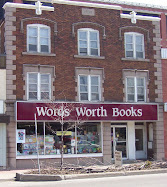
Well not really, but with Chuck on sabbatical, Bronwyn and I have taken on the bulk of the buying at Words Worth, and this could change how I read.
Technological changes aside, books are marketed pretty much as they have been for years. Good and bad book reviews influence what gets in the door and how much of it. There are still newspapers of note, and blogs that I check constantly but there’s a closer relationship with various publishers sales representatives who sell their firms seasonal titles.
One of my favourite people in that regard recently put me onto a novel that we had in the store last year.
It didn’t do much in hardcover and was due shortly in paperback.
This sales rep said something to the effect that “you should have a look at this, I think you may really take to it” while noting (they are in sales after all) that we didn’t sell the hardcover too well.
Most sales reps are duty bound to let the world know about the “big” books coming out particularly in the fall (by the way, the first sentence of the new Dan Brown novel in September will be “Robert Langdon awoke”) but the good ones have a real knack for getting the smaller gems into enthusiastic hands.
And so, a thank you to the underpaid staffers of Penguin Canada for David Benioff’s City of Thieves.
The hook is fairly simple. Two young Russians are spared prosecution during the Nazi’s siege of Leningrad by an influential Soviet colonel. He’s proposed to bury their crimes if they can procure a dozen eggs for use in his daughter’s wedding cake.
Bodies are stacked like chord wood and even bread is made from things inedible, but Lev and Kolya pool their talents in a desperate and at times comic attempt to expedite the impossible request and save their skins.
An historic city beset by lawlessness and the German war machine carries the novel along like a tank.
City of Thieves is in pre-production as a film and its Benioff’s talents as a screen writer (Kite Runner) that lend an especially episodic air to the tale.
Often, aspects of a novel that stand out especially can carry the work even if the author can’t sink every ball on the table.
Coming of age tales during wartime are everywhere, but I’m hard pressed to find a weak point in Benioff’s game. His treatment of Russian literary history is seamlessly woven into the story; his tone is smooth whether City of Thieves is brutal or comic. The multitudes contained in the character Kolya are wonderful.
It’s to Benioff’s credit that he didn’t let Kolya run wild and risk overwhelming other characters in the novel. His professorial/maddening riffs on war, literature, love, sex and everything else are wonderful in an informal setting.
To top it off, the eternal teenager in me notes what I now believe to be the single greatest putdown one man has ever delivered unto another.
Lev, the narrator and sidekick to Kolya meets and falls in love with Vika, an enigmatic Resistance fighter with a crack shot, and he plays an epic chess match for the highest stakes possible with a barbaric German officer Abendroth. Lev’s back story and his skill as a straight man make Kolya’s bombast all the more memorable.
As I raced through the book, I noticed small similarities with Jonathan Safran Foer’s acclaimed first novel, Everything is Illuminated. As good as it was Benioff is a more assured and subtle writer.
Even when the author is clearly nodding to classic storytelling convention, his originality and fine touch is such that his bag of tricks feels entirely new.
City of Thieves is the whole package, a literary novel with a knockout punch.
I frequently grumble that novels are overlong and the better of the bunch are knowingly short.
Very seldom do I wish a novel to be longer than it is. Thus, City of Thieves will have to be reread until David Benioff’s next book.
Alongside the euphoria of a book this good, I always lament that I didn’t get to it sooner and mourn again the books I miss while reading the equivalent of “Robert Langdon awoke.”

Tuesday, April 21, 2009

Little Britain

I'm not sure about this effort to prop up the British thriller vs "the reign of the production-line American thriller writers."

For openers, I didn't know the British thriller was in danger of being swamped, but it seems every time someone brings a flag into debates like this, they end up looking silly.
Yes, the American juggernauts of Patterson, Grisham etc. are formulaic, but surely the spokesperson isn't serious when he suggests..

"We feel the genre has been quite neglected in the last seven to eight years ... There haven't been any new writers coming through. It might be because there aren't any very good writers, or maybe it's because publishers and booksellers have been neglecting it..."

There haven't been any new thriller writers coming through?
Rather than post an outraged reply made up entirely of links I'll let the audacity of that statement collapse on its own, or perhaps the term "thriller" needs some urgent redefinition.

Posted by Dave

Impulse buying and uh..what was I talking about?

Steven Johnson asks the only question that matters around e-books.

"Because they have been largely walled off from the world of hypertext, print books have remained a kind of game preserve for the endangered species of linear, deep-focus reading. Online, you can click happily from blog post to email thread to online New Yorker article -- sampling, commenting and forwarding as you go. But when you sit down with an old-fashioned book in your hand, the medium works naturally against such distractions; it compels you to follow the thread, to stay engaged with a single narrative or argument.

The Kindle in its current incarnation maintains some of that emphasis on linear focus; it has no dedicated client for email or texting, and its Web browser is buried in a subfolder for "experimental" projects. But Amazon has already released a version of the Kindle software for reading its e-books on an iPhone, which is much more conducive to all manner of distraction. No doubt future iterations of the Kindle and other e-book readers will make it just as easy to jump online to check your 401(k) performance as it is now to buy a copy of "On Beauty."
As a result, I fear that one of the great joys of book reading -- the total immersion in another world, or in the world of the author's ideas -- will be compromised. We all may read books the way we increasingly read magazines and newspapers: a little bit here, a little bit there."

I've never read an e-book as such, but I know I read differently on screen than on the printed page. That may just be age, but if we all read on screen and flit about as readers, I wonder who will be left to write the sort of deeper focus works that are going to document "us" before the ADD becomes a default setting. I hope I'm wrong, but....

Posted by Dave

Friday, April 17, 2009

Too big to fail, but not too big to suck

After Amazon's censorship freakout/innocent mistake/whatever there are some wondering if big lumbering giants are bad for the neighbourhood.

"Even if you buy Amazon's thin explanation for how it errantly miscatalogued all those books, the episode leaves behind some significant concerns.The concentration of information in such large, trusted sites doesn't just threaten to throttle the flow of commerce when ham-fists go awry, but also the representation of what, well, exists. These private companies are becoming vital to the public sphere, so when something is amiss, and massive protests ensue, it's not just angry authors venting. Amazon really has become too big to fail.

Apparently is you're a large enough company the distance between being too big to be trusted with "what, well, exists" to being too big to fail is a single sentence.

As with most things, the final word should probably go to Richard Nash.

Posted by David

Thursday, April 16, 2009

This way to the unveiling


The One Book, One Community pick for Waterloo Region is here

I'm afraid I've now gotten around to the Book of Negroes, but sales of the book are already very strong, and OBOC always works very well around here.
Posted by Dave


Tuesday, April 14, 2009

Amazon's bad week

For all the froth, not everyone is happy with their Kindle and the virtual bookstore is a bit squeamish.
And kind of ham handed about it.

Moby breaks down the backpedaling and obfuscation here.

Posted by David

Monday, April 13, 2009

Derek Weiler

Terrible news from Quill and Quire.
Derek Weiler, Quill's editor has passed away.
There was likely no one as young with such influence in the Canadian book trade.
Tragically, he was only forty years old.
The obit will appear in the local paper tomorrow.

There are links relating to Derek here.

God, this is sad.

Less time to sleep

One of my favourites holds forth on a few short story collections of note, and rightly laments their relative status.

"You might have thought that in our own attention-deficient age, a narrative art based on speed and brevity would have become the main attraction, but outside the creative writing workshop, where its small scale makes it convenient for study (a dismal basis for survival), that hasn't been the case. Lack of encouragement may be the cause, or it may be something inherently skittish about whichever muse presides over this delicate art: a reluctance to settle anywhere long enough to generate a heavy-duty literary industry. It may be the relative newness of the form (if you accept Turgenev's claim that "we all come out from under Gogol's Overcoat", you can date its birth precisely to 1842), or it may be that people regard it as somehow highbrow or artsy; an insider sport for practitioners and aficionados only. Whatever the case, people still seem to want their blockbusters."

Everything Ravaged, Everything Burned has been widely reviewed, and Chimamanda Ngozi Adichie can do no wrong, but most short story collections need an advocate to find their mark.
My man Lasdun is a good bet as his work with short fiction is rock solid.

Posted by Dave

Sunday, April 12, 2009

Advance Men

The NY Times has a neat little essay on the world of advance payments to writers, and how deals are; and used to be structured.
Most everyone agrees that big numbers turn small in a big hurry.

"Take a reported six-figure advance, Roy Blount Jr., the president of the Authors Guild, said in an e-mail message. “That may mean $100,000, minus 15 percent agent’s commission and self-employment tax, and if we’re comparing it to a salary let us recall (a) that it does not include any fringes like a desk, let alone health insurance, and (b) that the book might take two years to write and three years to get published. . . . So a six-figure advance, while in my experience gratefully received, is not necessarily enough, in itself, for most adults to live on.”

The money stat, as it were, is that seven out of ten books published don't earn out their advance.
On the whole this makes most of the industry still a hobby, just as it was about a hundred years ago.
As an aside, it's nice to know that Walter Kirn is getting some movie money for his novel Up in the Air, a neat little novel about one man's relentless grab for frequent flier points.

Posted by Dave

Wednesday, April 08, 2009

Oh my

There's nothing I don't like about this.

A review from Jessa (with picture!) of a current favourite of mine.
Props to NPR whom I adore as well.

Posted by Dave

For the time being.....

Thanks much friends and well wishers, and on some level a shout out to a few favourites is in order.
Now can anyone do something about the weather?

Posted by Dave

Tuesday, April 07, 2009

Excellent Interview with Wayson Choy


Here is an interview with Wayson Choy for his new book, "Not Yet".


Don't miss out when he comes to town on Wednesday May 13th to read with Anne Michaels.

Buying Local


HI folks, this is Sally Melville (knitting author), who will be signing at WORDSWORTH May 5. In preparation for that event, I'm posting here--and I'll start by saying that the most bizarre day of my life happened in California where a man offered me $50 million to start a chain of yarn shops. (This was back in the heydey of knitting when there wasn't enough yarn to satsify demand.) Obviously, I didn't do this: if I had, I would be the most hated person in the yarn world, sucking all available fibre into the black hole of a chain, killing little locals. So I thought about why I don't like chains. And here's my list.


They aren't sensitive to their demographic.
They aren't sensitive to their geography.
They don't pay their staff as well.
They hire fewer staff per square foot than small retailers.
They don't put as much money into the local economy.
They don't give as much money to local charities.
They don't have the unique character a local shop does.
They are usually in outlying areas, which requires that I drive some distance from where I live.
They specialize in lower end goods.
They usually have a much more limited range of inventory.
They're often so big that I have to wander through lots of stuff I don't want to find the thing I do want.


What is the single advantage to a chain?
Lower prices.
Period. I can spend money on gas to drive to outlying areas to wander around—looking for service—through an inventory with fewer choices and yarns of lower quality than I might find at my LYS. Wow.
I understand needing to save money in tough times. But what price have we paid for saving these few dollars? I'm not an expert on global economies, but it seems to me that by giving our business to the large chains, we have squeezed out our little downtowns and their locally-owned shops, and how well has that served our towns, cities, local economies, and society in general?
While I don't know much about all this stuff, there are people who do. One of them is Jane Jacobs—a brilliant thinker who wrote some very important books. Perhaps her most well-known was The Death and Life of Great American Cities. The one I have read was Dark Age Ahead.
In this latter book—which I have lent out and so cannot quote—I remember reading that successful societies (ones that have survived longer than ours) are expensive. They support their artists, their teachers, their child-care providers, their disabled, their aged, their workers, their suppliers of goods. They don't outsource for cheaper goods: they pay what they must to support the care and welfare of their community's citizens.
Since we might all have fewer disposable dollars in the times ahead, we may now be looking at what she called an expensive society. So how do we make the best use of our spending dollars? Look for cheaper goods? There are people who will tell you that the solution is to shop at WALMART. But I could not disagree more. I believe that what we need to do is behave as if we are part of expensive but successful society. This means that we look very carefully at where and how we spend our money. And it seems to me that supporting our communities--by buying goods and services from our small, local, independent businesses--is a first step in the road to recovery.
--Sally Melville

Monday, April 06, 2009

And the hard hats as part of the uniform? Genius!!

The Star notes the shiny new independent opening up in Toronto.

'Launched in 1981 by McNally's mother, Holly, McNally Robinson has expanded to include two stores in Winnipeg and another in Saskatoon. A Calgary location closed in 2008 after six years, but the family retains a foothold in New York with a kindred outlet, McNally Jackson, managed by McNally's sister Sarah.
The McNally Robinson business plan crosses the retail advantages of a big box store with the homespun sensibility of an independent. At 20,000 square feet, the Don Mills operation will include specialty sections devoted to children's books, music and the like, as well as a licensed, 80-seat restaurant serving everything from tea and muffins to steak and wine.'

Good wishes from here (with just a bit of envy- twenty thousand square feet is a LOT of room)

Posted by Dave

Saturday, April 04, 2009

Anne Michaels & Wayson Choy

are both featured in the Saturday Globe today.
An excerpt from Choy's memoir Not Yet and a rave for Michaels' long awaited second novel, the Winter Vault are featured.
Stephen Hayward's review notes that,

"This is a book that proposes great themes: a critique of progress, an exploration of the nature of human suffering, an interrogation of the relationship between past and present. And yet, for all of that, it remains at bottom a deeply affecting love story about intimacies and distances that grow, shift and dissolve between people — and about how we all carry within us a secret place where we store our wounds until the world thaws adequately for us to bury them.
Anne Michaels, in short, is back."

They share a stage here and tickets are available, free with purchase of either of the books.

Posted by Dave

Friday, April 03, 2009

Like a Cockroach, Twitter could survive an apocalypse

Reports on the death of newspapers and the rise of online media kings like Twitter are everywhere of late and I’ve wondered for years about the impact of such a seismic shift on book culture. But recent attempts to start an in store book club have illustrated rather clearly what worked and what didn’t in terms of even getting a simple message out.
I’ve wanted to put together a monthly book club for men for a year, and a few weeks ago we put the word out via our website, the blog and our Facebook page.
It netted two emails indicating interest.
Granted, men are not reading in comparable numbers to women but it was disheartening nonetheless.Salvation arrived in the form of the local paper getting wind of the attempt and a brief piece appeared the next day.Three days later we’re at about fifteen or twenty names and counting, more than enough to get started.
Perhaps this only illustrates demographics, luck or that a Record reporter checks out our place once in awhile, but it’s hard not to wonder given the state of play in the newspaper industry; what we may lose if they become entirely digital enterprises or fade away entirely.
Gallows humour aside the book business is relatively rosy compared to the humble daily paper.
After years of trying subscription models, pouring money into a web presence and finally cutting to the bone, newspapers are going bust.
This has ramifications for all manner of discourse, but when media is both fragmented all over the internet and the 500 channel universe, and at the same time subject to more and more corporate concentration; this presents an odd happenstance for the nuts and bolts gathering of local news.
In an interview with the Guardian, David Simon, former newsman and executive producer of the HBO series the Wire warns that newspapers are the last bastion against a new age of corruption.
‘Oh, to be a state or local official in America over the next 10 to 15 years, before somebody figures out the business model," says Simon, a former crime reporter for the Baltimore Sun. "To gambol freely across the wastelands of an American city, as a local politician! It's got to be one of the great dreams in the history of American corruption."
It’s simply too soon to tell if a Web-driven community presence can replace solid local reporting, but for now Simon is having none of it. "The internet does froth and commentary very well, but you don't meet many internet reporters down at the courthouse."There are plenty of Web 2.0 voices ready to refute Simon’s arguments but no one can claim to know what will replace a decent, or even an average daily paper.The idea of a social network or a few dozen blogs in Anytown, North America doing the expensive work of newsgathering may sound dubious to a seasoned reporter but it’s a distinct possibility in several mid-size American cities.
Mark Morford of the San Francisco Chronicle (in better days they had the best book review section in North America by the way) writes,
“In the howling absence of all the essential, unglamorous work newspapers now do -- the fact-checking, interviewing, researching, all by experienced pros who know how to sift the human maelstrom better than anyone, and all hitched to 100+ years of hard-fought newsbrand credibility -- what's the new yardstick for integrity? On what do you base your choices? Some fickle mix of personal mood, blood-alcohol level, and how many followers your given source has on Twitter? Right.
Like the Globe and Mail’s Margaret Wente , I may be getting too old to “get” Twitter as anything other than a narcissistic time suck, but as the future of newsgathering?
Again, the response to our book clubs from print vs online media doesn’t have to mean anything definitive in terms of the effectiveness of on form over another when it concerns local news coverage, but as long as the public purse is bailing out businesses that don’t have to cater to the public good; how about a bailout for newspapers?

Thursday, April 02, 2009

The difference between an epiphany and the whole of your office not talking to you is...

Jeez Random House, I love you and everything; and some of my very favourite people work for you, but fer Chrissake how did you ever let this get as far as it did?

From Moby Lives:

"Crown president and publisher Jenny Frost admitted she had “come to her senses” after being “virtually shunned” by “just about everybody in Random House.”
“I have to admit, I was charged about publishing a president, even this one,” she said. “Some friends cornered me one day and said, ‘This guy had to steal two elections to get air time, and you’re paying him millions to stay in the limelight?’ But I didn’t listen. I was just thinking about taking him to Michael’s for lunch.”
So what changed Frost’s mind? “Well, I was walking down the hall in Random House one day, and no one would make eye contact with me, and then I ran into my boss Markus Dohle, and he said, ‘Look, I like to make money as much as the next guy, but you know, the entire world’ — he has that cute accent, it came out ‘the entire vorld‘ — ‘the entire world thinks of this guy as a murderer. After all, he is responsible for the deaths of not only thousands of soldiers, but hundreds of thousands of innocent civilians.’ And I thought, well, jeez, he’s right.”

That would be George W, and the original advance for his book was $7 million.


So now they can piss that money away on....?

Posted by Dave

IMPAC Awards

The finalist for the IMPAC award has been announced, and it's a tough call.
Of course I'm going with Junot Diaz, but it's always good list.
The Canadian Rawi Hage won last year for Deniro's Game.

The final five are:

The Brief Wondrous Life of Oscar Wao by Junot Diaz (Dominican / American) Riverhead Books
Ravel by Jean Echenoz (French) in translation. The New Press
The Reluctant Fundamentalist by Mohsin Hamid (Pakistani / British) Hamish Hamilton / Harcourt / Doubleday Canada
The Archivist's Story by Travis Holland (American) Dial PressThe Burnt-Out Town of Miracles by Roy Jacobsen (Norwegian) in translation. John Murray Publishers
The Indian Clerk by David Leavitt (American) Bloomsbury Publishing
Animal's People by Indra Sinha (Indian / British) Simon & Schuster
Man Gone Down by Micheal Thomas (American) Grove / Atlantic

This year is different because one of my favourite people to argue over the list is no longer with us.

Posted by Dave

Oh, purity


I always feel better with a small press book in my hand.

There's a bit of undiscovered country that feels secretive and small in an almost nurturing way.

Not that one of my favourites isn't already punching above its weight, but The Confessions of Noa Weber, both a philosophical and spirited tale of a young Jewish woman's love for the enigmatic and sadly deceased Alek is a winner so far.

I'm only a third through it, but a full review is forthcoming.


Posted by Dave
Related Posts with Thumbnails