Monday, September 27, 2010
Milestone
No sleep 'til Fresno?
“[I want to give] them a sense of what Brooklyn street life is like, taking them into the neighborhood. Which, you know, Boerum Hill is kind of posh these days. To get the texture part of me craves, and that I want them to experience, it might be better advised to Astoria or some remoter part of Brooklyn where there's attention and excitement and the juxtaposition of fresh immigrants, fresh gentrification, and all that confusion and tumult that was the signature of my own coming of age.”
It's just a drag, is all.
David
Thursday, September 23, 2010
Historical Fiction & Fantasy Author Jack Whyte Waterloo

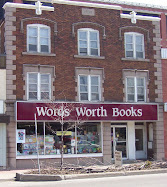
Words Worth Books is looking forward to our instore event with Jack Whyte. This is the second time he has come to Waterloo to promote his historical novels. Thursday October 7 - 7pm - Free In-store 100 King St. S in Uptown Waterloo. Parking on King St., or off of Caroline st. in the Waterloo Town Square lot. |
In the pre-dawn hours of August 24, 1305 a.d., in London's Smithfield Prison, the outlaw William Wallace, who is to be executed at dawn, is visited by a Scottish priest who has come to hear his last Confession. So begins The Forest Laird, the first book in Jack Whyte's masterful new trilogy. Wallace's story leads us through his many lives—as an outlaw and a fugitive, a hero and a patriot, a rebel and a kingmaker. He is the first heroic figure from the Scottish Wars of Independence brought blazingly to life in Jack Whyte's new trilogy, the Guardians, and will be followed by his two compatriots Robert the Bruce, King of Scots; and Sir James Douglas, known as The Black Jack Whyte was born and raised in Scotland and emigrated to Canada in 1967. He is an actor, orator, singer, and poet, and was awarded an honorary Doctor of Letters (D.Litt.) for his contribution to Canadian popular fiction. He is the author of the internationally bestselling Dream of Eagles series and the Templar Trilogy. He lives in Kelowna, British Columbia. The following are three video interviews in which Jack discusses this new series: |
Monday, September 20, 2010
The Book of Small
• David Bergen for The Matter With Morris (Phyllis Bruce Books/HarperCollins)
• Douglas Coupland for Player One (House of Anansi Press)
• Michael Helm for Cities of Refuge (McClelland & Stewart)
• Alexander MacLeod for his short story collection Light Lifting (Biblioasis)
• Avner Mandelman fo The Debba (Other Press/Random House of Canada)
• Tom Rachman for The Imperfectionists (Dial/Random House of Canada)
• Sarah Selecky for her short story collection This Cake Is For The Party (Thomas Allen Publishers)
• Johanna Skibsrud for The Sentimentalists (Gaspereau Press)
• Cordelia Strube for Lemon (Coach House Books)
• Joan Thomas for Curiosity (McClelland & Stewart)
• Jane Urquhart for Sanctuary Line (McClelland & Stewart)
• Dianne Warren for Cool Water (Phyllis Bruce Books/HarperCollins)
• Kathleen Winter for Annabel (House of Anansi Press)
The list tightens up on Oct 5, and the big day is Nov 9
The bigger day is two days later when Alison Pick drops by
Friday, September 17, 2010
20 Writerly Questions with Sandra Birdsell

Sandra Birdsell was born in 1942 in
1.How would you summarize your book in one sentence?
A man who believes that nothing happens without a reason winds up fleeing his creditors in a stolen RV, only to be stranded on a Wal-Mart parking lot where his and his wife’s fate are decided. (whew!)
8. What’s your favourite city in the world?
My husband
No
I use both laptop and pen & paper.
The voice of the work usually determines that for me.

Tuesday, September 14, 2010
Hmmm.....
It ain't easy being virtuous
Monday, September 13, 2010
Guest Post by Alissa York

Alissa York will be joining us at our event on October 26th.
For more information on the event can be found HERE.
Alissa has written a guest post for our blog:
Where am I? It’s a thought I’ve gotten used to over the past few months—one might even call it a pervasive state of mind. It’s always a little disorienting coming up for air after the extended deep-sea dive of writing a novel, but this time the experience has been even more bewildering than usual. Why? Because, for the first time ever, the world around me bears an uncanny resemblance to the world portrayed in the book. Fauna took me into uncharted waters: namely, the here and now.
My last novel, Effigy, is set in nineteenth-century Utah—territory I’d never dreamt of exploring until a certain child-bride taxidermist grabbed me by the imagination and wouldn’t let go. The novel before that, Mercy, takes place in the 1940s, in a made-up Manitoba town. Even the short stories in my first book, Any Given Power, tend to unfold in fictional or unnamed communities. How strange, then, to find myself working on a contemporary novel set in and around my own Toronto neighbourhood. It was a powerful process: it changed me, and it changed the way I see the city I’ve chosen to call home.
Regardless of where and when a book is set, there’s no denying the relief you feel when it’s finally done. No more tinkering with timelines and fleshing out scenes, no more agonizing over who will fall in love and who will die—at least not until the next time around. But there’s a sense of loss as well; you miss the immersive experience, the sense of purpose, the very characters themselves. There’s nothing for it but to let go. The “work-in-progress” has somehow become “the work.” It doesn’t need you anymore.
Which isn’t to say it stands alone. In one sense a finished book is a fait accompli, but in another, very real, sense it remains a mutable creation. Over the years, I’ve come to learn that there are as many incarnations of a novel as there are people who turn its pages. That’s why I love to do readings—they offer the chance to connect with readers in person, and to check in on a book’s continued evolution in the world. When you’re lucky, they also offer the opportunity to meet and read with writers whose work you admire (the names Birdsell and Lyon come to mind). See you soon, Words Worth Books and Waterloo readers—I’m looking forward to it!
Friday, September 10, 2010
Perfect!
"Emerging from a conversation with Lorin Stein, the new editor of The Paris Review, Jonathan Galassi, the president of Farrar Straus Giroux, publisher of “Freedom,” rejected Ms. Weiner’s word, as defined. In German, he pointed out, “freude” means “joy.” “This,” he said extending his arm to indicate the revelers —“is Franzenfreude” — Joy in Franzen. When he first read the manuscript, Mr. Galassi recalled: “I wrote him and said, it’s clear you’re the great novelist of our generation. That’s what’s happening here.” Another guest, the book critic Laura Miller, who is moderating a reading club for “Freedom” on Salon.com, agreed. “To say the book is hyped is just ridiculous. He’s not Lady Gaga. We picked a book we knew a lot of people would be wanting to read.”
And this is why Laura Miller is the greatest American ever.
David
Tuesday, September 07, 2010
Booker Shortlist
Sunday, September 05, 2010
a couple reviews of note
David
Saturday, September 04, 2010
Franzenfreude?
Friday, September 03, 2010
she's baaaaaccckk
Whereas from where I sit the authors that matter are the ones that can say something intelligent and thought provoking that a reasonably smart person can digest and enjoy. If you need a scholarly background to decode it, it might be great art but to what end? You might as well be writing in Latin.
Franzen: That's one of the perverse, not to say fetishistic responses to the obliteratively ubiquitous presence of buying in our lives: to say, "I don't buy the popular stuff, I buy the small label stuff," as if that makes you any less of a consumer. But I'm somewhat guilty of it myself, and it follows a pattern. Certainly in music, suddenly the band you like because it was not produced goes to a major label and becomes heavily produced. It's hard to think of a major label Mekons recording, for example. It's impossible because they would never do it.
But I'm with you, I don't think the same applies to fiction. The problem in this case is some of Oprah's picks. She's picked some good books, but she's picked enough schmaltzy, one dimensional ones that I cringe, myself, even though I think she's really smart and she's really fighting the good fight. And she's an easy target.
But as far as being popular, yeah, I think Dave Barry is really funny. And Silence of the Lambs is a really smart book. But of course everybody who's sold out and been co-opted, as I obviously have, says the same thing, and it makes for a pathetic spectacle."
Yep, pretty much, says I.
David