Wednesday, June 30, 2010

Attention All Educators!


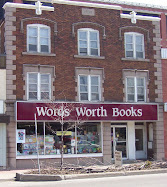
We're planning a Book Sale (20% OFF!) for Educators at Words Worth Books on a special night in September!

On an evening in September, Words Worth Books is hosting an Educator Appreciation Night which features 20% off all titles on our shelves (excluding specialty orders). Stock up on books for the classroom and educator resources on this fun and casual night of getting to know and support local educators.


Fill in the form below to be notified of this future event!


Saturday, June 26, 2010

Win a SIGNED copy of The Book of Awesome!


Based on the wildly popular blog 1000 Awesome Things, The Book of Awesome is hilarious, heartwarming...and well, AWESOME!

Read an interview with the author at The Globe & Mail.

Win a SIGNED copy! Contest runs until July 11th! Good Luck.

Thursday, June 24, 2010

yes, but

Harper Collins actually has a pretty solid fall catalog, but the only thing anyone is going to be talking about is this.

Monday, June 21, 2010

A good day to stay in bed

I can't help but feel that these stories are linked somehow.
Sigh.

Friday, June 18, 2010

When you make 'em this good...

The knock on Alan Furst is that if you've read one of them, you've read them all. But there are subtleties that belie that opinion as evidenced by his new book, Spies of the Balkans.

I've just gotten started, but Furst isn't one to rush, and the reader shouldn't either.
In fact, I wonder if there's a reason to read his stuff during the World Cup.
All that smoldering European intrigue at once!

The NY Times weight in here.


Thursday, June 17, 2010

Don't Cry

Dave loves Mary Gaitskill!
Here are a few videos of Mary reading at the recent Open Book festival in T.O.


Wednesday, June 16, 2010

Publishers are scrambling, booksellers are cheering

Fer Gawd sake, Random House has had a Steig Larsson in their midst for years with Jo Nesbo.
Why are they just finding out about this now?

"Scandinavian writers who have had small but devoted followings are now seeing their books showcased alongside Mr. Larsson’s extraordinarily popular series. The intense interest in the Larsson books prompted the staff at Powell’s Books in Portland, Ore., to create a special section in the store for two dozen Scandinavian mysteries, by Karin Fossum, Jo Nesbo, Kjell Eriksson and Yrsa Sigurdardottir."

Mmmmm.. I do love Jo Nesbo, and it's very gratifying that Arnaldur Indridason is now being "marketed directly to fans of Mr. Larsson."
We've been doing that for a couple years now, yo.

Friday, June 11, 2010

FIFA Madness

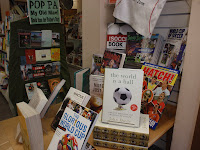
So Dave and I are already jumping around the front of the store because South Africa tied Mexico in the first game of the world cup. I think the rest of this month is going to be a bit crazy around the store - except to hear a lot of hoots and hollers as we get updates on games throughout the day. To celebrate I had a blast putting together a great display of all thing soccer. You can read about some of Dave's favorites HERE


*The Hunger Games* by Suzanne Collins


The Hunger Games by Suzanne Collins is a cross between Lord of the Flies and 1984, mixed with the television program, “Survivor”.
This is a futuristic novel where Panem, the country that has replaced North America, has a lottery in each of its twelve districts every year of one girl and one boy, to fight to the death in a televised games arena. The “games” are punishment for an uprising that was held in the country 75 years earlier. The story is told in the first person by Katniss Everdeen who chooses to replace her 12 year old sister, Prim, the pick from the lottery. Because the story is in the first person we know she is going to win the games but how she does it and what the games involve kept me reading far into the night.
The first of a trilogy, I rushed back to the store to get the second volume, Catching Fire, which I whipped through in a day it was so intriguing. Now I have to wait until August to get the final volume, Mockingjay!
Tricia
The Hunger Games is available in paperback in early July!
Mockingjay is available on August 24th!

Thursday, June 10, 2010

More Sh*t for Dad!

Some of my favorite funny books for Dad:

Sh*t My Dad Says by Justin Halpern
After being dumped by his longtime girlfriend, twenty-eight-year-old Justin Halpern found himself living at home with his seventy-three-year-old dad. Sam Halpern, who is "like Socrates, but angrier, and with worse hair," has never minced words, and when Justin moved back home, he began to record all the ridiculous things his dad said to him:
"That woman was sexy. . . . Out of your league? Son, let

women figure out why they won't screw you. Don't do it for them."
"Do people your age know how to comb their hair? It looks like two squirrels crawled on their heads and started fucking."
"The worst thing you can be is a liar. . . . Okay, fine, yes, the worst thing you can be is a Nazi, but then number two is liar. Nazi one, liar two."
Justin weaves a brilliantly funny, touching coming-of-age memoir around the best of his dad's quotes. An all-American story that unfolds on the Little League field, in Denny's, during excruciating family road trips, and, most frequently, in the Halperns' kitchen over bowls of Grape-Nuts, Sh*t My Dad Says is a chaotic, hilarious, true portrait of a father-son relationship from a major new comic voice.

C'mon Papa by Ryan Knighton
Ryan Knighton's humorous and perceptive tales of fatherhood take us inside an unusual new family, one bound by its father's particular darkness and light.

C'mon Papa is Ryan Knighton's heartbreaking and hilarious voyage through the first year of fatherhood. Becoming a father is a stressful, daunting rite of passage to be sure, but for a blind father, the fears are unimaginably heightened. Ryan will have to find novel ways to adapt to nearly every aspect of parenting: the most basic skills are nearly impossible to contemplate, let alone master. And how will Ryan get to know this pre-verbal bundle of coos and burps when he can't see her smile, or look into her eyes for hints of the person to come?

But this is no pity party, and Ryan has no time for sentimentality. Tackling these hurdles with grace and humour, Ryan is determined to do his part - and this is where the fun starts. From holding his daughter as she wails into the night to their first nerve-wracking walk to the cafe, no activity between father and daughter is without its pitfalls. In his struggle to "see" Tess, Ryan reimagines the relationship between father and child during that first chaotic year.

Where's my wallet?

I've always said that if I wasn't here I'd love to be working at Politics and Prose, the iconic bookstore in Washington D.C., where it's part of the routine to have President's and nationally known muckety mucks drop by.
Turns out Politics and Prose is for sale.

"Authors, book industry insiders and longtime customers reacted with concern to news of the sale. One tweet read: "Oh no. Dismay." Novelist and journalist Jim Lehrer, who has often promoted his books at the store, said that "putting Politics and Prose up for sale is like putting the Washington Monument up for sale."

Sounds like a spot that's ripe for a bailout.

With any luck, they'll find someone who will keep the shop in good stead.
Maybe someone who can find a way to make a buck off of
this.

David

Wednesday, June 09, 2010

Just when I thought I couldn't love her more

Slagging another writer and the publishing industry as a whole is tough to do in the same interview, but to do it after being given a pretty sweet award is quite a rope trick.

Only someone with the steely gaze of a Lionel Shriver could pull it off.


From the Independent,

""It'd be totally hypocritical to discourage people from joining my profession, which was good to me in the end, but I have qualms about being encouraging. The odds are stacked against you. I want to give people enough of an idea of the capriciousness of the industry."

She went on to cast aspersions on the successes of some best-selling authors whose writing was simply not very good, she thought, but whose books were aided by the benefit of the powerful publishing publicity machine – citing Bret Easton Ellis' latest book, Imperial Bedrooms, as one such example.

"There are a lot of books that end up selling that aren't very good. I've just read Bret Easton Ellis' new book and it's awful but it's had a big publicity campaign.

"I'm writing a 1,500 word review of it – the size of which alone will overwhelm what I say. It's not a case of cream rising to the top but skimmed milk rising – of the 'no fat' kind. The book doesn't deserve the attention. It's ghastly. In the meantime, there are lots of books that will not be reviewed," she said."


Never mind the rough economics of the writing game, folks. The real fear is in getting reviewed by a bombproof novelist.

Monday, June 07, 2010

*Review* and Q&A for The Passage by Justin Cronin


Where will you be when the lights go out?

The Passage by Justin Cronin arrived on my desk in March as an advance reading copy. I looked at the 766 page tome and at the premise of the book and thought "Nope, not for me".

And then I took it home one Friday night on a whim and can now only agree with Stephen King's review: "Read fifteen pages and you will find yourself captivated; read thirty and you will find yourself taken prisoner and reading late into the night. It has the vividness that only epic works of fantasy and imagination can achieve. What else can I say? This: read this book and the ordinary world disappears."

The story takes place 20 years or so in the future. At an army research station in Colorado, an experiment is being conducted by a top secret U.S. military operation: twelve men are exposed to a virus meant to weaponize the human form by super-charging the immune system. So far the experiment is going as planned, according to the "experts" running the facility. Then they decide to test their work on a little girl. Amy has been abandoned by her impoverished mother until she is rescued by Brad Wolgast, the FBI agent who has been tasked with handing her over to the research team.

"It happened fast. Thirty-two minutes for one world to die, another to be born."

First, the unthinkable: a security breach at the facility unleashes the monstrous product creating a night of chaos and carnage that never ends. Civilization swiftly crumbles into a primal landscape of predators and prey.

Fast forward to 100 years later: The U.S. is now a desolate landscape dotted with remote groups of people living in exiled communes. They must keep the lights on all night as to protect themselves from the monsters of this failed experiment. One group in California is aware that the electricity that they depend on for survival will not last. They are not aware if any other humans have survived. They are losing their history. Until a teenage girl named Amy walks out of the forest and into their lives.

This is not the type of book that I am drawn to. I am not a big mystery, fantasy or Sci-Fi reader by any means. Perhaps this book fits into those categories. However I don't really care - the story is addictive and the writing is like watching a movie take place on your inner eyelids. I felt intrigued, thrilled, terrified, nervous, happy and on the edge of my seat while reading The Passage. Whenever I had to put it down my brain screamed to pick it up again. I was devastated when I finished it only to realize that this is the first in a trilogy. I called my sales rep to demand to know when the next one is coming out and was so disappointed when he didn't have an answer.

Justin Cronin was inspired to write this book after a conversation he had with his young daughter. She admitted that she never read any of his books (he has also written Mary O'Neill and The Summer Guest) because they looked boring. He started to get defensive and then stopped and asked her what she would like to read instead. Her answer: a story about a girl who saves the world. That story is The Passage. Make sure you bring it with you on your holidays this summer. Available in hardcover on June 8th - place your order now!

-Bronwyn

And this Q&A with Justin Cronin was just sent to us by Random House. Enjoy!

Born and raised in New England, Justin Cronin is a graduate of Harvard University and the Iowa Writers’ Workshop. Awards for his fiction include the Stephen Crane Prize, a Whiting Writers’ Award, and a Pew Fellowship in the Arts. He is a professor of English at Rice University and lives with his wife and children in Houston, Texas. His newest novel, The Passage, is published by Doubleday Canada.
20 Writerly Questions for… Justin Cronin
1. How would you summarize your book in one sentence?
Girl saves world.
2. How long did it take you to write this book?
47 years. But most of it in the last 3.
3. Where is your favorite place to write?
Rome is nice. But usually I write in my office over the garage. I used to write IN the garage.
4. How do you choose your characters’ names?
Like my children's names, they seem to come from above.
5. How many drafts do you go through?
Three at least. In the second draft, I add. In the third, I cut. Often I have to do this more than once.
6. If there was one book you wish you had written what would it be?
Currently, Joseph O'Neill's NETHERLAND.
7. If your book were to become a movie, who would you like to see star in it?
I think Russell Crowe would make a great Agent Wolgast.
8. What’s your favourite city in the world?
Houston, TX, because my children live there. It's home.
9. If you could talk to any writer living or dead who would it be, and what would you ask?
Shakespeare. How did you do it?
10. Do you listen to music while you write? If so, what kind??
Only the music of the spheres.
11. Who is the first person who gets to you read your manuscript?
My wife, Leslie.
12. Do you have a guilty pleasure read?
Reading is too virtuous an act to make me feel guilty.
13. What’s on your nightstand right now?
A galley of Alan Furst's new novel, SPIES OF THE BALKANS; Ian McEwan's SOLAR; Colum McCann's LET THE GREAT WORLD SPIN; Danielle Trussoni's ANGELOLOGY; Graham Green's THE HEART OF THE MATTER; three pairs of eyeglasses.
14. What is the first book you remember reading?
SWALLOWS AND AMAZONS by Arthur Ransome.
15. Did you always want to be a writer?
I always liked to write. As for being a writer, that kind of crept up on me during my 20s.
16. What do you drink or eat while you write?
I don't eat, but I drink a lot of coffee. Diet Coke in the afternoon.
17. Typewriter, laptop, or pen & paper?
None of the above. I use a desktop computer with a screen the size of a baby pool. I can see four pages at a time. I sometimes compose on legal pads. I use colored drawing pencils because they're softer.
18. What did you do immediately after hearing that you were being published for the very first time?
It was long ago (1988), so I'm not sure. Probably I had to sit down for a few minutes, and then went for a long run.
19. How do you decide which narrative point of view to write from?
This decision always seems to be made for me by the kind of story I'm trying to tell. It's the one aspect of a novel I've never really had to think about very hard.
20. What is the best gift someone could give a writer?
Be nice to my children. And if you feel like doing some babysitting, that would be great.

*Review* The Phantom Tollbooth by Norman Juster


The Phantom Tollbooth by Norman Juster is awesome! Somehow, growing up, I missed out on this smart, kooky, classic of kids literature.

I was the kind of kid that was always claiming to be “bored” just like Milo, our boy-hero in the book. One day Milo comes home to find a miniature toll booth in his room. For lack of anything better to do, he decides to play with the toll booth, only to be transported another world. The kingdom of Wisdom is where Milo ends up, a strange place filled with dangerously literalized language. He soon meets up with an ally in Tock, a dog with the body of an alarm clock.

Tock and Milo end up going on a quest to rescue the twin princesses Rhyme and Reason, who have been imprisoned in a castle in the air by their brothers, rival kings that can’t stop arguing whether words or numbers are better. Milo and Tock are chased by all sorts of terrifying demons that are actually just sloppy uses of language. Next time some one uses a threadbare excuse or a makes a gross exaggeration, I’m totally calling them out for being demons of ignorance. I’m hoping somehow that referencing a kids book at the same time as I criticize people’s use of language will make me seem less pedantic.

The language play in this book is so entertaining! Perhaps a bit too subtle for some younger readers, though it might inspire them to soak up learning the same way Milo’s adventures awaken him to the fascinating world of knowledge around him.

Such a great find! It’s inspired me to take a look at some other quirky classics of kids lit…
-Caroline

Thursday, June 03, 2010

Some of the Funniest Stuff I have ever read:

Catherine Gildiner is a riot! I have read her two memoirs, Too Close to the Falls and After the Falls. She has also written a novel called Seduction. Catherine is a very funny writer and just as hilarious when she has done author events with us. After the Falls was released in paperback at the end of April. This is an excerpt from her recent newsletter to her fans:

A long, windy winter

There are actually a few things that are new. Thank God it is spring and every bud is new and glorious in a pristine pale green at my farm. (It is prob

ably already summer in most of the US.) We are recovering from a mild hurricane that took out six trees by the roots and then proceeded to blow down my drive shed which was the size of a barn and had withstood all gales for 125 years. I found the trees thrown hundreds of feet, and the drive shed looked like the house of straw in The Three Little Pigs after the wolf blew it down. I hope you all made it through the winter in better shape than my drive shed.

For those of you who think that farm life is safer than city life, read on. Last August I was walking along a country dirt road. A tractor came down the road hauling a huge hay baler on the back. A wire from one of the bales had worked its way loose and hung flapping off the side of the truck. The wire caught my foot and wound itself around me like a serpent, threw me up in the air twelve feet, and then dragged me behind the tractor. I broke a few bones in my neck and back. I guess I went haywire. However, it is hard to keep a 62-year-old angry Irish high-jumper down. I am again up and hopping and writing the third volume of my memoir called
The Long Way Home. It is about my life from ages 21 to 25 in England, the US, and finally Canada. Stay tuned for that one.

Her memoirs are just like this excerpt - full of serious events seen through a veil of humour and laughter. If you ever need a pick-me-up, read either of her memoirs. They are my grumpy day cure! -Bronwyn

The Reason We Do This...

Thank you, independent booksellers, for honoring Kate DiCamillo with the 2010 Indies Choice Award for "Most Engaging Author" at the American Booksellers Association: Celebration of Bookselling luncheon last week!

Elise Supovitz
Director of Field Sales
Candlewick Press

Kate's "Most Engaging Author" Acceptance Speech - May 26, 2010
"When I was in second grade, I fell in love with Abraham Lincoln.
The Clermont Elementary School library had a series of books called Notable Young Americans. And in this way, through these books, I met George Washington and Helen Keller, Alexander Graham Bell and Thomas Edison, Amelia Earhart and Booker T. Washington.
I met them and I liked them.
But it wasn't until Abraham Lincoln that I fell in love.
Something about his story (the poverty, the death of his mother, his love of words and books) resonated with me, moved me. I came home from school and told my mother everything that I had
learned about the young Abraham Lincoln. I told her that I wanted to learn more.
My mother took me to the Cooper Memorial Library in downtown Clermont. They had there many books about Honest Abe, but there was nothing for a reader my age. And so my mother checked out a thick volume on the life of Abraham Lincoln written for adults. The text was impenetrable. After a few pages, I gave up on it and contented myself with looking at photographs of the man, his sad and hopeful face.
That year, for my eighth birthday, my mother gave me a hardcover biography of Lincoln called Meet Abraham Lincoln by Barbara Cary. It was written at my reading level. There were wonderful illustrations, and I was smitten with the man anew.
Where had my mother found that book? At Porter's Stationery and Gifts in Eustis, Florida. Eustis was the next town over from Clermont, thirty miles away. At Porter's, they had looked for a book about Lincoln that was at my reading level and they had special-ordered it for my mother, for me.
Also, they had told my mother that there was another book I might like. It was called The Cricket in Times Square. And so, in addition to a book about a poor, lonely boy who went on to be come president of the United States, I also received the story of a small cricket who loves music, a cricket who sings so beautifully that people stop to listen.
Who was that bookseller who thought, "Here is an almost-eight-year-old girl who loves Abraham Lincoln. What other book will she love? Oh, yes. This book about a cricket."?
There was nothing logical about that decision. It was a leap of faith.
Those two books changed me.
Together, they cemented an idea in my eight-year-old heart. That idea was this: It doesn't matter how small, how lonely, how broken or sad or poor you are. There is a way to make yourself heard. There is a way to sing.
A bookseller put those books into my mother's hands, and my mother put them into mine.
Sometimes we forget that this simple, physical gesture can change lives.
I want to remind you that it does.
I want to thank you because it did."

- Kate DiCamillo
May 26, 2010

copyright (c) 2010 by Kate DiCamillo

Wednesday, June 02, 2010

Waiting for the World Cup?... What to Read While You Wait!

In some circles I shared a fairly famous moniker growing up. Lorne (Gump) Worsley was a Hall of Fame goalie in the NHL from the mid-1950's to the early 70's. When I was asked about being related I fudged a bit, but I read his biography when I was eleven, so I knew enough to fake it.
Gradually, hockey lessened as my sport of choice (my brother is the goaltender in the family) and soccer started to creep in. I still remember the European Food Mart in downtown Kitchener near my old high school as being where I first got a taste of the passion the beautiful game evokes. The 1982 World Cup went to Italy that year and being in a deli with all that good food watching a lovely establishment full of people going progressively more insane as June became July made a big impression. I didn't speak a word of the language, but I made a point of hanging around.
A poster of the Italian team took up half the shelf space in the place, and likely contributed to theshop closing for all I know. At the time it probably didn't matter much. With sports writers currently wondering aloud if Canadians are going to watch the Stanley Cup finals now that Montreal is out, it's telling that an entire planet is going mad for the upcoming World Cup.
For entry level or seasoned fans alike, there are a couple of offerings that will accent the proceedings. The Sun Guide to the World Cup is a great little compendium of the teams, the major players and a ton of stats. For less than $15, it's essential stuff and great for resting a pint on.

For a bit more substance, John Doyle's The World is a Ball:The Joy, Madness and Meaning of Soccer is a traveling man's look at the last few World Cups and European Championships from the perspective of a fluid writer, knowledgeable fan and apparently an excellent drinking companion. The Globe and Mail's TV columnist knows from spectacle and it shows.

One of the joys of soccer at an elite level is how differently it's played from continent to continent. Broad brushes aside, the European game differs from the South and Central African variety, and as for the Africans well... whenever African teams put a scare into the powerful European clubs, it makes for an electrifying spectacle. Doyle does this particularly well. He's great when describing an upset in the making and is equally able to convey the artistry of Brazilian soccer and the elan common to the French game, as well as what it all means off the field.
Soccer is politics, history, and inexorably linked to the blood of many dozens of nations. Doyle illuminates many of them and has a good deal of fun doing it, sometimes on the Globe and Mail's dime; occasionally on his own. He makes the point early that he's not a sports writer and The World is a Ball is no mere sports tome. Rather, Doyle gets out of the stadium and onto the streets and bars to get a look at fans the world over. The result is a breezy, funny and poignant look at nothing less than what makes most of the world tick.
Some grumpy reviewers have indicated that the book doesn't go into a great amount of detail about teams, tactics and minutiae. True enough. There's plenty of that elsewhere with reams of material for specific teams and players. This is a book for emerging fans in North America who are embracing the game or would like to. It's also a great piece of travel writing, and a near perfect prelude to what is by far the biggest sporting event on the planet.
I greatly enjoyed the recap of the time when I came of age as a fan, and to whet one's appetite for the 2010 World Cup (June 11 in South Africa) one can't do much better than to dive into this.
Dave

*The Shallows: What the Internet is Doing to Our Brains* by Nicholas Carr


Over the past year or so, I’ve been alarmed by an appreciable decline in the number of books I have read and the ease with which I've read them. A part of that is to do with fixing and selling my house and having the fix it skills of a duck.
But too much of the time I’d sit in the right chair with a favourite drink and after a few pages I’d start to hear the siren song of a sink full of dishes or some chore that needed doing.

But most often it was the persistent allure of the internet and a host of favourite websites that suddenly needed checking; or no particular sites at all. Invariably, the evening would collapse into itself and I’d resolve to read more tomorrow.
On one of those indistinguishable nights I stumbled on an essay in the Atlantic Monthly by the American writer Nicholas Carr, who described my disquiet.

“My mind isn’t going-so far as I can tell-but it’s changing. I used to find it easy to immerse myself in a book or a lengthy article. My mind would get caught up in the twists of the narrative or the turns of the argument, and I’d spend hours strolling through long stretches of prose. That’s not the case anymore. Now my concentration starts to drift after a page or two. I get fidgety, lose the thread, and start looking for something else to do. I feel like I’m always dragging my wayward brain back to the text. The deep reading that used to come naturally has become a struggle.”

The essay, of which this was a part-- “Is Google making us stupid?” wasn’t an attack on Google, but rather a worrisome chronicle of Carr’s increasing inability to read as he once did.
In addition to scaring the hell out of me, I resolved to read Nicholas Carr’s book on the subject the day it arrived.

The lament at Words Worth and from all walks of literate life is that there are great heaps of books out there and no one seems to have time to read them.
It was thought that the Web would take a bit out of television, but media types tell us that TV use has remained fairly constant. It's reading that being pushed out and Carr rightly worries about the consequences, not from some preachy notion of reading being good for us, but specifically what the neurological consequences of reading on a medium that encourages distraction, with links to ever more places and where doing several things at once gets balled up with productivity.

The Shallows expands dramatically on the aforementioned essay by looking at the history of technology as it relates to reading; the rise of the internet giants that we are all familiar with today, and perhaps most importantly; Carr collects an impressive amount of data pertaining to neuroscience and the history of our relation to text. From here, he's gentle, but resolute as he points out the differences in comprehension around how we used to, and how many of us currently engage with it.

Without a hint of the polemic, Carr uses study after study, in multiple contexts to point out that people who read text the old fashioned way, understand it better and retain more than those who traipse through a text festooned with hyperlinks.
The current fetish from some publishers is to tart up young adult books with links, video; basically anything so long as it isn't mere words. Bronwyn brought to my attention just this morning a bookmark given to her primary school kids that advertises a website that advertises "an online collection of animated, talking picture books which teach young children the joys of reading in a format they'll love."

Time was, we had parents for that, but the salient point is that Carr's research around brain science puts the lie to all this. This is where our guy's thesis becomes money in the bank. Carr’s contention that our highly malleable brains (he makes good use of books like Norman Doidge’s The Brain that Changes Itself) are being compromised by near continuous exposure to information as presented by the Internet, as opposed to the ways of Carr’s youth. More than that we are falling victim to a use it or lose it scenario in which our “plastic, not elastic brains don’t snap back to their former state the way an elastic band does. They hold onto their changed state. And nothing says that the new state has to be a desirable one.”

The hyperlinks and short staccato-like bursts of information synonymous with Internet reading aren’t right or wrong in and of themselves, but they do appear to comprise a wholly different way of consuming text and Carr builds a persuasive argument that this new bag of tricks comes at a price.

I took much of the brain science research as an article of faith (footnotes are present) but the way research meshes with Carr’s experience as a writer and reader make the book exciting, timely and an urgent warning.Carr is evenhanded enough to recognize that those with interests to protect will posit that the Internet is a grand tool and that advances around movement of information outweigh any concerns, or that the empirical evidence Carr has gathered isn't sacrosanct. But I recognized myself far too easily in his warning, and I can take steps to put things right.

While the Web has been a godsend to writers, now able to do much general research in seconds, Nicholas Carr mightily illustrates the devil’s bargain we are making with our collective heads as readers. And Internet or not, distracted reading makes for bad writing.

Dave

Book time for Father's Day

Just a couple suggestions of great books for Dad:

The Boy in the Moon by Ian Brown
Walker Brown was born with a genetic mutation so rare that doctors call it an orphan syndrome: perhaps 300 people around the world also live wth it. Walker turns twelve in 2008, but he weighs only 54 pounds, is still in diapers, can’t speak and needs to wear special cuffs on his arms so that he can’t continually hit himself. “Sometimes watching him,” Brown writes, “is like looking at the man in the moon – but you know there is actually no man there. But if Walker is so insubstantial, why does he feel so important? What is he trying to show me?”

In a book that owes its beginnings to Brown’s original Globe and Mail series, he sets out to answer that question, a journey that takes him into deeply touching and troubling territory. “All I really want to know is what goes on inside his off-shaped head,” he writes, “But every time I ask, he somehow persuades me to look into my own.”

The Father's Are Coming Home by Margaret Wise Brown
(famous author of Goodnight Moon)

As night falls, the fathers come home. The rabbit hops home to his bunnies; the dog returns to his puppies; the bird brings home a worm and sings a song. And the boy's father, who is a sailor, comes home from the sea.

Simple, lyrical words and pictures tell this timeless story, a heartfelt tribute to the love between fathers and their children.

We're all over this one, too.

well Bronwyn is.

"But if “The Passage” shares anything else with “Twilight,” it may be pure commercial frenzy. In the publishing industry, “The Passage” has been hyped as one of the hottest books of the summer. At the annual book industry convention in New York last week, it was advertised on a banner roughly the size of a city bus, hanging from the ceiling in the vast convention hall. For those attending, 13,000 name tags were emblazoned with the title and a spooky image of a dark, empty forest that is also on the cover of the book.

So far, booksellers have expressed early and passionate enthusiasm. “The Passage” was chosen as an Indie Next List pick for June; Library Journal predicted that the book would be one of the most popular novels of the year; and Publishers Weekly raved, “Fans of vampire fiction who are bored by the endless hordes of sensitive, misunderstood Byronesque bloodsuckers will revel in Cronin’s engrossingly horrific account of a postapocalyptic America.”


Booksellers expressing early and passionate enthusiasm. Just another day at the office, yo.

Notes on a Scandal?

Rick Warren's (Purpose Driven Life) new book is postponed indefinitely.

Tuesday, June 01, 2010

Cookies for Kids...

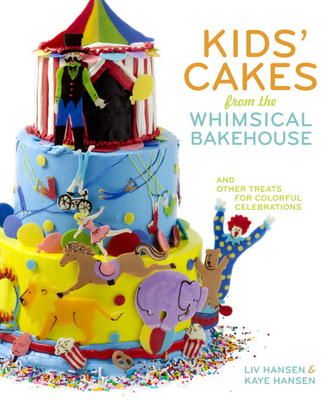
I am so excited about this new gorgeous cake book. I'm not sure if I can create any of these but it's fun to look at the photos and imagine cakes for my kids birthdays!
Random House was very kind to send us some sample recipes that we can post. Let me know how your results are. YUMMM! -Bronwyn

Balloon Cookies
By Kaye Hansen and Liv Hansen
From Kids’ Cakes from the Whimsical Bakehouse

I found my balloon cookie cutter online, but if you can’t find a “party balloon” cutter, an egg, snow globe, or diamond ring cookie cutter will also work.

Yield: approximately 24 cookies

What you will need
Cookies: 24 Lemon Butter Cookies (see below)
Icing: 1 recipe (or 1 cup) Simple Lemon Glaze (see below)
Decoration: twenty-four 6- or 8-inch lollipop sticks
Colors: red, yellow, green, blue, and pink liquid gel colors (or choose one color)
Miscellaneous: half-sheet baking pan, 3-inch balloon cookie cutter, pastry cones

1. Bake the cookies and let them cool completely. Prepare the Simple Lemon Glaze.

2. Place 1 tablespoon of glaze in a pastry cone and cut a small hole at the tip. Prepare the colored icing using the remaining glaze: approximately 3 tablespoons each of red, yellow, green, blue, and pink.

3. Spread a thin layer of the colored icing over each cookie. Do not hold the cookies by the lollipop stick while spreading; instead, hold the cookie or keep the cookie on the sheet pan. Use the uncolored glaze to pipe a “white” highlight on the upper right side of each balloon. Let the cookies dry overnight.

Note: The lemon glaze reacts with the colors; purple turns immediately gray when mixed in, and what is initially a vibrant red (or yellow, green, or blue) may frost over as it dries—but they are still quite pretty. If you want pure colors, use Royal Icing (page 15).

Kids can
Have your child help cut out the balloon-shaped cookies and arrange them on the half-sheet pan. Teach them to press firmly into the dough so the cookie cutter cuts all the way through, and then give the cookie cutter a little shake, which will release the cookie. Then show them how to scoop up the cookies with a spatula and slide them onto the sheet pan.


Lemon Butter Cookies

The addition of cream cheese to the dough gives these cookies a slight tang that you don’t get from a plain butter cookie. I added lemon zest to give it some extra zing, and I was quite pleased with the flavor and texture.

Yield: approximately 24 cookies

Line 2 cookie sheets with parchment paper.
Preheat the overn to 350°F. Have all ingredients at room temperature.
In the bowl of an elecric mixer at medium speed, mix 1 minute to combine:
4 ounces (1 stick) unsalted butter
3 ounces cream cheese

Add and mix to combine:
1 ½ cups confectioners’ sugar

Add and thorooughly incorporate:
1 extra-large egg
½ teaspoon pure vanilla extract
1 tablespoon finely grated lemon zest

On a piece of wax paper, sift together:
2 ¼ cups all-purpose flour
1/5 teaspoon baking powder

Add the dry ingredients to the butter mixture.
Mix until the dough comes together.

Wrap in plastic wrap and chill for 30 minutes.

On a lightly floured board, roll the dough out ¼ inch thick. Cut out with balloon cookie cutters.

Arrange the cookies 1 inch apart along the long sides of the cookie sheets. Carefully insert 6- or 8-inch lollipop sticks about ½ inch into the bottom of the balloons.

Bake for 8 to 10 minutes, or until lightly colored. Let the cookies cool in the pans for 5 minutes, then transfer the cookies to a wire rack to cool completely.

SIMPLE LEMON GLAZE

Sift into a bowl: 1 cup confectioner’s sugar, plus additional if needed. Slowly whisk in: 1 tablespoon strained fresh lemon juice, plus additional if neeed. If the icing is too thin, whisk in more confectioner’s sugar by the tablespoonful. To tint the glaze, add food coloring drop by drop until you have the desired color. Use the glaze immediately or place plastic wrap directly on the surface of the glaze. It can be stored in the refrigerator for 1 week.

Excerpted from Kids’ Cakes from the Whimsical Bakehouse Copyright © 2010 by Kaye Hansen and Liv Hansen; Photographs by Ben Fink. Excerpted by permission of Clarkson Potter, a division of Random House of Canada Limited. All rights reserved. No part of this excerpt may be reproduced or reprinted without permission in writing from the publisher.
Related Posts with Thumbnails